

Can you take an unopened razor on a plane? That’s a question that a lot of men have, and for a very good reason. If you care about your looks and hygiene, you do want to shave every couple of days. Otherwise, that beard will get out of control. But there are all kinds of methods you can use in order to shave. Yet all the time, you need a razor to remove the unwanted hair, and that can be rather tricky to do. Which is why you have to wonder, can you fly with a razor, and is it allowed to do that? The answer is not as simple as you will find out below.
Quick answer: Yes — you can take a razor on an airplane, but only certain types in your carry-on. Disposable razors, cartridge razors, and electric shavers are allowed in hand luggage. Safety razors with the blade inserted and straight razors must go in checked baggage; the handle without the blade is fine in carry-on.
It always depends on the type of razor that you want to use.
For example, if you want to go with an electric razor, then those are allowed in carry-on and checked bags. That’s an important thing to note, because you won’t always have this option. And then we have disposable razors. Those that are fully disposable will be allowed in the carry-on luggage, along with replacement cartridges and blades.
However, if you have a safety razor, those are not allowed in the carry-on luggage if you have the blade on them. If they don’t have the blade, they are good to go. Blades will be something you can add in the checked luggage, so you can still get them and travel with these, but it will take a bit of a hassle to deal with, so try to take that into consideration!
What’s the current regulation after the TSA re-evaluation?
So, can you take a personal razor on an airplane? According to the TSA rule set, they do allow safety razors as long as there is no blade in the carry-on. The blade has to be removed before you enter the screening checkpoint. And another important aspect to consider here is that the TSA officers can’t remove the blade from the holder themselves. They are not allowed to do so.
This means you have to remove the blade yourself and put it in your checked luggage. Or, in the other cases, you may need to actually throw it away and buy a blade when you arrive. That’s always up to you, but it is a very interesting approach when it comes to getting a razor on the airplane. Sharp objects are not allowed in your carry-on for obvious reasons. You have to circumvent this by putting any blades in the checked luggage. Allowing sharp objects in the carry-on would be a major risk for all people on the plane. It’s just a much better idea to keep this in mind.
Do they allow electric razors in your carry on?
Yes, because these electric razors are seen as not something problematic that could bring any type of danger. It’s just a much better idea to allow electric razors in the carry-on and in the checked luggage, because they are convenient and a pleasure to use. The main reason they are allowed is that they do not have a removable blade. Instead, the blade itself is embedded within the razor itself, and thus it can’t be removed. That’s why it can be a great idea to take into consideration. In doing so, you will have a much better result, and you will find that it delivers a much better value every single time.
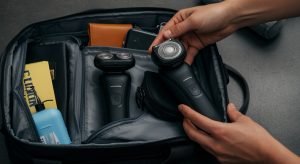
Electric razors are versatile, and some might have a battery, so you want to see if that battery is ok to fly with. Some types of batteries can lead to an explosion when they are at a very high altitude. Obviously, that will not always be the case, but there’s definitely something to consider and focus on, which is what you need to consider. You can inform yourself about the battery or accumulator type, and if it’s something you can take on a plane. Most of the time, you can do it, and it’s important to think about this type of stuff.
Electric Razors and Batteries: The Rule Worth Knowing
The section above correctly says electric razors are allowed in both carry-on and checked bags. What’s missing is the battery rule, and it’s the part that actually trips people up.
If your electric razor or trimmer runs on a lithium-ion battery, aviation safety practice is to keep that battery in the carry-on, not the hold. The logic is simple: if a lithium battery ever overheats, the crew would much rather it happen where someone can see it and deal with it than in an inaccessible cargo hold. This is the same reason spare power banks are carry-on-only across virtually every airline.
In practice, that means: traveling with just a carry-on? Your electric razor rides along with no issues. Checking a bag and tossing the shaver in it? Make sure the razor is switched fully off — and if it has a travel lock, engage it — so vibration can’t wake it up mid-flight. Some shavers also pop the shaver out at the security scanner alongside their laptop and liquids if an officer asks; it’s not required everywhere, but it speeds things along at stricter checkpoints.
One more thing worth knowing: this battery logic is also why cordless heat-styling tools (curling irons, flatirons) are banned from checked bags outright. Your shaver isn’t a heat tool, so it doesn’t fall under that ban — but the underlying principle, batteries stay where the crew can reach them, is the same.
Can you take a disposable razor on the plane?
It’s possible to take a disposable razor in your cargo luggage, but also in your carry-on luggage. The problem appears when blades can be removed. But in the case of disposable razors, you can’t remove the razor. And that alone can prove to be useful since you don’t need to go through the hassle of removing any blade. It can be effective and reliable, and you can easily take the razor with you anywhere you see fit.
Plus, the whole reason disposable razors exist is that you can take them into your hand luggage, use them a few times, and throw them. They don’t have a blade that’s very powerful. So because of that, you can take them both in the checked-in and carry-on luggage. Which is important to take into consideration here. That’s why you always want to learn as much as you can about what razor types you can take with you while traveling.
Of course, there’s always the option to try to buy disposable razors at the destination. That way, you can still shave and not worry about taking any razors with you in the checked-in or carry-on luggage. At the end of the day, it always offers you the convenience and value you want, while also saving a huge amount of effort and time.
Safety razors: are they allowed?
One of the most important things to consider when it comes to safety razors is that most airlines don’t allow you to take them into your hand luggage. A safety razor can have its blade removed. Since any type of double-edged blade is forbidden in the cabin, you see airlines not allowing the transport of safety razors in the carry-on. Of course, that can vary based on the airline. But most airlines, specifically the larger ones, will not allow you to place these safety razors in the carry-on.
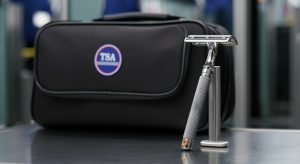
If they encounter safety razors in the carry-on, you will usually be forced to throw them away. Or if you have checked luggage, you can transfer them from here to there. It’s a very good idea to keep in mind, because you want to be fully prepared in case there are issues with the airline providers. It’s a very good idea to ensure that you avoid taking safety razors with you in the carry-on luggage.
Shavettes: The Gray Area the TSA Doesn't Clarify
Here’s a question the official guidance quietly skips: what about a shavette — the straight-razor-style handle that takes disposable blades?
TSA’s published guidance talks about cartridge razors, safety razors, and straight razors, but shavettes get no explicit mention. In practice, that ambiguity resolves against you. Travelers on shaving forums report that screeners treat a shavette as a straight razor — even with no blade installed — and the blade situation is identical to a safety razor: loose blades belong in checked baggage, full stop.
The practical advice from frequent flyers is consistent: don’t try to carry a shavette through security, blade or no blade. If you’re checking a bag, the shavette (without a blade) plus your blades ride in the hold with no issues. If you’re going carry-on only, a shavette is the wrong tool for the trip — grab a disposable or cartridge razor for the travel kit and leave the shavette at home.
Why the hard line? It comes down to the officer’s discretion at the scanner. A shavette *looks* like a straight razor on the X-ray, and no screener is paid to debate taxonomy with you at 6 AM. As one forum veteran put it: don’t make the security staff make a decision, because you may not like what they decide. The same logic applies to an expensive safety razor handle, by the way — even though an empty handle is technically permitted, many travelers refuse to risk a prized razor on one officer’s judgment call.
What about razor cartridges and individual blades?
First of all, we need to know what a razor cartridge is, and that’s a detachable head with a razor blade embedded in it. That means you can easily remove the blade from the handle and replace it as you see fit. The important thing to note with this is that you can take the cartridge itself on the plane, both in your carry-on and in your checked luggage.
However, you can only take it on the plane without razors. If you want to add a blade to the cartridge, then you can only put these in the checked luggage. Otherwise, if the TSA people or airline team checks the luggage and sees the razors in there, they will ask you to throw them away. You will not be allowed to fly with these, which is something to keep in mind. Realistically, any type of blade that’s removable can prove to be a major danger for anyone on the airplane. So that’s why you will not be able to take the razor on the airplane adequately. It’s a crucial aspect to keep in mind, and it will only make things better in the end.
We recommend avoiding any rush when it comes to figuring out what razors you can take on the plane. As we said earlier, if you wonder if you can bring a razor on a plane, the answer is that you can. But if the blade can be removed from the razor, then that will bring in its fair share of difficulties. Understanding that and narrowing down the best option is only going to make things better in the end. It will also help if you read the airline rules when it comes to the stuff they allow and what’s not allowed. In doing so, you will have a good idea of what they allow, what’s ok, and what is not ok!
Flying Carry-On Only? The Wet Shaver's Playbook
This is the scenario the forums argue about endlessly: you travel light, you refuse to check a bag, and you still want a proper shave at your destination. Here’s the playbook that experienced traveling wet shavers actually use.
Option 1: Mail blades ahead. The most-loved workaround on the shaving forums is almost embarrassingly simple — post a small padded envelope of DE blades to your hotel or your host before you fly. Blades are light, cheap, and perfectly legal in the mail. Land, shave with your own razor and your favorite blade, and either bring the leftovers home in checked baggage on the return or leave them behind.
Option 2: Buy blades at your destination. Double-edge blades are sold in pharmacies and supermarkets in most of the world, often for less than you’d pay at home. It won’t be your exact favorite brand, but for a week-long trip, close enough beats a checked bag.
Option 3: Travel with a “sacrificial” razor. Many dedicated DE shavers keep a cheap cartridge razor or a pack of disposables permanently in their travel kit. It’s not their daily driver — it’s the tool that flies without drama. Some also keep a budget DE handle (the kind you wouldn’t mourn) for trips where they do check a bag, so the good hardware never leaves the house.
The golden rule — repeated like scripture on every travel thread: *never take anything on a trip that you would hate to lose or damage.* Confiscated items are gone for good; hotel bathrooms eat more strops and razors than TSA ever has. And remember the fallback that costs you nothing: airside shops and every chemist at your destination sell disposable razors. It won’t be the shave you’re used to, but it will get you through the week.
Do airlines have different regulations when it comes to taking razors on a plane?
People always ask themselves, can you fly with a razor or not? And most airlines will not allow you to fly with a razor that has a removable blade. If the razor doesn’t have a removable blade, like the disposable or electric razors, you can take those in the checked luggage without a problem. But they will not allow you to bring that in the carry-on luggage. It can become a major issue to have those blades on the flight, so you really need to pay attention to that kind of stuff.
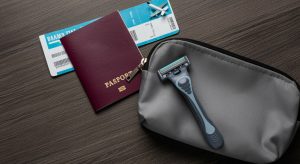
If you choose to travel and want to take a razor with you, checking the airline’s rules is very important. Sure, most of them won’t allow a razor whose blade can be removed. But sometimes, it will end up being a situation where you could be allowed. As always, every airline can set its own restrictions while also taking into account the current regulations.
Beyond the TSA: How the Rules Change Abroad
The TSA rules above cover flights departing the United States. Once you’re traveling internationally, the departure country’s security authority sets the rules at the checkpoint — and while the broad strokes are similar worldwide, the details can bite.
United Kingdom: The UK’s gov.uk guidance is explicit and worth knowing because it’s stricter in one notable way — razor blades are prohibited in hand luggage even if they’re still sealed in their original packet. The packaging doesn’t change what they are. Disposable razors and electric shavers are allowed in both hand and hold luggage. And shaving foam counts as a liquid, so the container must be 100 ml or less. An empty safety-razor handle without a blade usually passes, but as UK shaving writers note, it’s ultimately the officer’s call on the day.
European Union: EU rules broadly mirror the UK’s — loose blades out, fixed-cartridge and disposable razors in. The 100 ml liquid rule applies to creams, gels, and foams across the board.
The universal principle: at every security checkpoint on Earth, the officer at the scanner has the final word. Published rules tell you what’s *supposed* to happen; the human being in front of you decides what *does* happen. That cuts both ways — most officers wave through a clearly bladeless handle without a second glance, and a few will confiscate first and ask questions never.
So before an international trip, check the aviation security site of your departure country (not just your airline), and when in doubt, default to the strictest interpretation: blades in the hold, disposables in the cabin, and nothing in your carry-on that you’d cry over losing.
Is it ok to take shaving cream in the hand luggage?
Another question that a lot of people want to know, aside from whether you can take an unopened razor on a plane, is whether you can take shaving cream as well. The short answer to that is yes, as long as the container is 100 ml or less. Generally, you can find some travel-sized shaving gels or creams. You should go with the 75 ml units, because those tend to be some of the best on the market, and they can provide a very good result.
Of course, you are free to choose what shaving cream you take and all the other things that you may need to bring with you. A lot of people choose to just buy shaving cream from their destination. But if you want to be fully prepared and take stuff with you on your own, it does make a lot of sense to opt for the smaller shaving cream containers. Go for a travel-sized unit, and you will find it to deliver a much better result, overall!
Can you ask the airline staff about taking razors in your luggage?
At that point, you’re already a bit late when it comes to asking someone. Instead, what you want to do is to talk with the airline first. That will give you a very good idea of what you can take with you and what items are not allowed. Learning all of that will help you narrow down all the info, and it will also help eliminate any concerns.
What other items are not allowed in the hand luggage?
Any razor with a removable blade will not be allowed if you have the blade there. Aside from that, there are other items that just aren’t allowed, like a petrol lighter, nail files, scissors with blades over 6 cm in length, chemical substances, flammable substances, tools that can be used as weapons, as well as pointed or sharp items.
Frequently Asked Questions
Q: Can you take a razor on an airplane?
A: Yes, in most cases. Disposable and cartridge razors plus electric shavers are allowed in carry-on bags. Loose safety-razor blades and straight razors are banned from carry-on and must travel in checked luggage.
Q: Can a safety razor be taken on a plane?
A: The handle can go in your carry-on, but the blade cannot — TSA prohibits loose double-edge blades in hand luggage. Pack blades in checked baggage, or buy them after you land.
Q: Are electric razors allowed on planes?
A: Yes. Electric razors and trimmers are allowed in both carry-on and checked bags on virtually all airlines, with no restrictions.
Conclusion
It’s always very important to ensure that you know what you can take with you on a plane and what’s not allowed. When it comes to razors, if the razor blades can be removed, you will not be allowed to take them in your carry-on luggage. Yes, you can place the blades in the checked luggage and take the razor without the blades in your carry-on. But as long as there’s an open blade that could be used as a weapon, airlines have a strict rule that does not allow this. Depending on the airline, they might have other requirements or stuff they are not ok with, so keep those things in mind as well!
One response to “Can I take a razor on an airplane?”
[…] about why you might be itching after shaving, what you can do to stop it, how to stop itching after shaving, how to make your skin feel better, effective products, and other hair removal choices that may be […]